
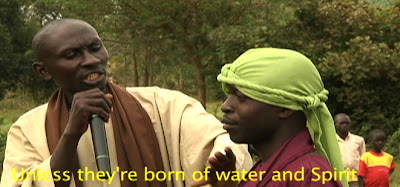
One of the pivotal scenes in Part 3 is when Jesus counsels Nicodemus and convinces him to be born again. If you want to go to heaven you must first be saved, He says. Working in community development I partnered with many faith-based organizations and attended their services on Sunday. Often the lessons of the Bible would be eclipsed by calls from the pastor in his sermon to recruit new members of the church. When the Ugandans found out that I was not Born Again they aggressively tried to save me. On one of the numerous occasions, I was in a parked car with a church member waiting for a thunderstorm to die down outside. We were making conversation to pass the time. One thing led to another and all of a sudden he was trying to save me. The more I resisted the worse it got. I felt like I was on a bad date at the drive-in. The rain couldn't stop quick enough.
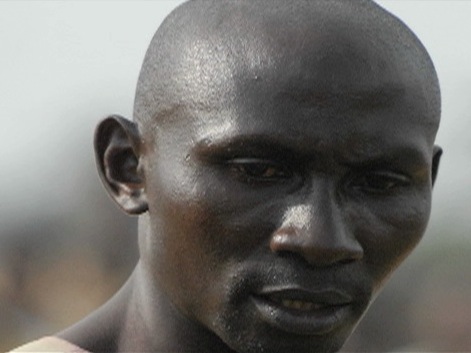 Christianity is relatively new to Uganda. One young woman, who was working on The Revealed Truth, became Born Again when she was a teenager. When her animist practicing parents found out, they chased her out of the house and disowned her. Nowadays, almost all Ugandans identify themselves as being Christian or Muslim and publicly denounce the traditional tribal religions. However animism is still practiced beneath the surface. Someone who is sick may go to the health clinic during the day, pray for a miracle in church in the evening, and secretly visit the witchdoctor in the middle of the night. There are regular reports of child sacrifice.
Obviously missionaries have a lot to do with with Uganda's religious fervor. They are responsible for a large portion of the country's humanitarian development work and nobly live out in the bush with the most impovrished. However, their gifts come with a trade off. Their mission is to recruit more Christians. Many are eager to sign up, but for what? A new religion or to receive foreign aid?
Despite my criticism of the Born Agains, I think that the religion does help to purify the souls of Uganda. The Masaka district has been hit hard by spells of bad luck, most recently with AIDS, but also with war. During the civil war in the 1980s both sides fought with child soldiers. I've met a few that have grown into adults. It has been suggested to me that by being Born Again they can finally step away from their old lives of violence and the circumstances they were forced into, and start again fresh. Being Born again gives them the psychological release to control their destiny.
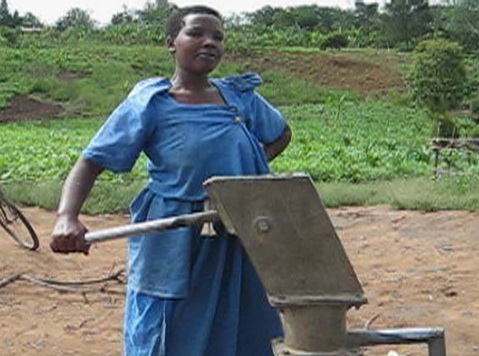 Finally, I'd like to have a look at the woman pumping water from the well. This is a little b-roll that I shot to introduce the Good Samaritan scene. This is actually where I collected my drinking water during the dry season when the rainwater tank down the street was empty. I'd carry two 40 liter jerrycan one and a half miles from this borehole to my house. It was easier to carry two rather than one because two gives you balance, plus it's a good workout. Eventually I found a man who delivered water to me for 13 cents a jerrycan. He told me that he makes more money that way than he did as a teacher. The majority of the population doesn't have indoor plumbing and so the village waterhole becomes the center of social life. Water's fetched mostly by women and children who carry it back home on their heads. The lady you see here wearing a traditional gomezi dress comes for water at least once day. Nothing has changed in the 2000 years between her and the Samaritan woman except that the hollowed out gourd has become a plastic jerrycan.
The Revealed Truth Blog Series
This post is the fourth of a nine part series that takes an in-depth look at the The Revealed Truth and how rural Ugandan culture influenced the making of the film. The movie is about an hour long but I've broken it down into 5 to 10 minute blog-size episodes. The next post will feature Judas.

The previous post was The Revealed Truth Part 2: Cross Culture Shock.


 Posts
Posts


