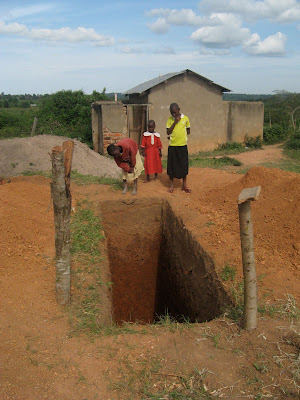
It probably wasn't the safest idea to dig a deep hole in the middle of a school and not take any precautionary steps to safeguard it from children falling in. Nevertheless, it's the first stage in the construction of a new VIP latrine at the school where I worked at in Uganda.
After the new toilets were built, speculation arose amongst the student body over who would inaugurate the facilities first. This documentary captures the excitement as the events unfold. On the day of the grand opening the students put on a show for the community. The program was filled with music, dance, and drama with a health and sanitation theme.
This isn't the porta-potty you remember from summer camp. It's a ten-stalled waste management system that will cater to over 1,000 school children and teachers daily for the next five years. I drew up this blueprint in case the need arises for you to build one of these structures at your own home.
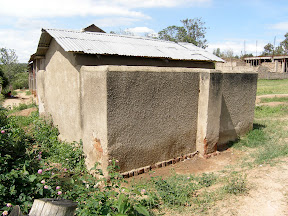
My small friend gave me a tour of the existing school latrine. It had been built eight years ago and all the traffic it's received has left the stalls messy. It was clearly operating beyond capacity. The pit had already filled up a year ago and the teachers would get sticks to compress the fecal matter back into the hole. It was time for a new toilet.
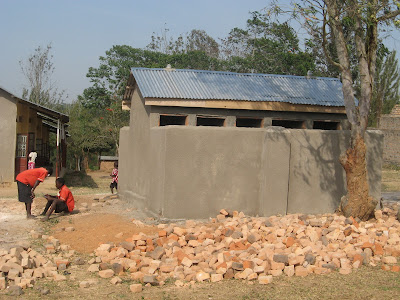
Here's a picture from the new long-drop. It's clean and inviting. If something falls down that hole it will take a few moments before you hear the reassuring thump that it's hit the bottom.
The new toilets were built in the shade of an old tree. The students found it to be an idyllic place to study and relax between classes.
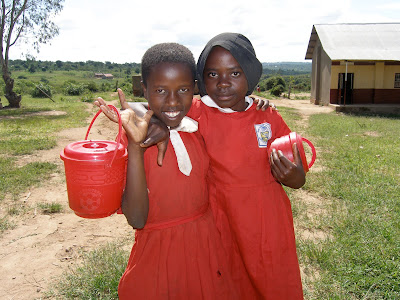
These girls are on their lunch break. There's probably bananas in those little red pales. Since the construction of the new latrine, there has been a marked improvement in the school's overall cleanliness. The girls can enjoy what they eat on the campus and stay healthy and happy.
The latrines were built with a small projects assistance grant from the Peace Corps and USAID. If you'd like to know more about the specifications of the latrine and the background of the community where it was built, you can read the original proposal.
There has also been a push recently to introduce composting toilets in the developing world. The waste is collected and used as fertilizer in gardens.
Grasshoppers are a ubiquitous snack in Southern Uganda. They are lured by lights, trapped in barrels, and then fried up in a little oil with salt. Kids love them and the ones you see enjoying them here are orphans from Nazareth Children's Home in Nyendo, Masaka.
Nyendo’s a suburb that sits 45 minutes away from the Equator on a stretch of highway that curves around Lake Victoria. It’s a place where busses from as far away as Kigali, Rwanda and Mombasa, Kenya stop in the middle of the night for their passengers to relieve themselves and stock up on street foods like meat-on-a-stick and fried lungfish. Grasshoppers are plentiful too. Teenage street vendors peddle nsenene from minibus to minibus with same entrepreneurial spirit as the guys who feel obligated to squeegee your windshield in New York.
The coming of the grasshoppers coincides with the end of each rainy season. You know it’s that time of year again when you see fluorescent floodlights pop up with the glow of a car dealership lot. Overnight they are set up in unlikely places. They span over several rooftops in slum areas, deep in the middle of swamps, or in a neighbor’s backyard. Often the traps are assembled where there was previously no electricity, but someone has shimmed up a nearby power line with a cable for a free hook-up.
The traps themselves are metal barrels fitted with a 10 foot piece of corrugated iron sheeting. The lights are aimed at the metallic surface and the grasshoppers become dazzled by the display, much like moths around a porch light. The insects are drawn into the brilliant luminance and whack themselves on the metal sheeting. Stunned, they slide down into the bottom of the barrel. At the end of the night they are collected in plastic bags and sold at roadside markets.
The Ugandan varieties of these insects are not the same grasshoppers that you’d find in America or Europe. They’re actually a type of katydid that are closely related to the same migratory locusts that plagued Pharaoh in the book of Exodus. Like Egypt, Uganda also sits along the banks of the river Nile (and Moses has always been a popular name), but the grasshoppers there are too delicious to pose a threat. However, if the insects weren’t eaten they could strip the lush tropical environment of its foliage. On one acre of land, fifty live grasshoppers (or two recommended serving sizes in fried snack form) have the same grazing power as a cow. For a country where 80% of its inhabitants’ livelihood depends on agriculture the result would be devastating.
Yet most Ugandans don’t see themselves as agents in pest control. They consume grasshoppers because they’re a nutritious snack. Every 100 grams of grasshopper contains a whopping 20.6 grams of protein. That’s as much as in an equivalent weight of beef. Many people in the impoverished, rural areas of the country are malnourished. Grasshoppers provide them with a cheap, and often free, source of nutrition.
Nsenene is a perfect afternoon snack for kids. The orphans in the video tried nabbing a few hoppers even before they were done cooking. Nazareth Children’s Home was started in 1978 by a woman named Josephine. Many of the children you see were dropped off on her doorstep in the middle of the night. Today the orphanage looks after 25 orphans who range in age from 1 to 20 years old. Josephine’s still around, but one of the older orphans, Nankya Carol, has taken up most of the home’s responsibilities. Carol’s the young woman in the video frying up the grasshoppers. She makes sure that the other kids are healthy and that they go to school. She also keeps a small garden that provides food for the orphanage. Nazareth Children’s Home loves visitors so if you find yourself around Masaka visit them. Their postal address is:
PO Box 86 Masaka, Uganda
If you can’t make it out to Uganda, I’ve done my best to piece together Carol’s Nsenene recipe below.
Grasshopper recipe:
Collect grasshoppers- as many as you can catch Peal wings and legs off Soak in water for 15-20 minutes Drain the water from pan Add a couple of tablespoons of vegetable oil Fry until golden brown over medium heat Stir occasionally to prevent burning Add salt to taste
I’d also like to thank Lisandro Torre, a Peace Corps volunteer, who served at Nazareth Children’s Home. He's the mysterious white hand in the movie that you see sampling the nsenene. Without his assistance, this video wouldn’t have gotten made.
Links The Internet is well versed on eating weird foods and Ugandan grasshopper culture is no exception. Here are some other blogs and websites on the subject. Many have their own variations to the classic nsenene recipe.
The popular Bizarre Foods show on the Travel Channel featured grasshoppers on its Ugandan episode.




 Posts
Posts


