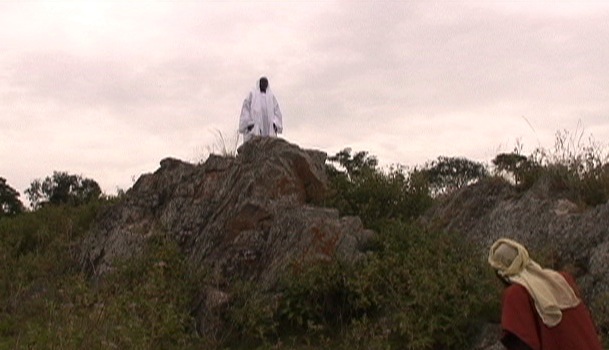
The ascension scene returns The Revealed Truth back to the AIDS ravaged fishing village from Part 1. After wading out of Lake Victoria, I remarked to the play's producer that the footage from the play's performance of the resurrection scene didn't come out too well. We decided to reshoot the scene in the bush down the beach from the village. The actor who plays Jesus, Pr. Josham Ssewanja, kept climbing up this hill. The cast and crew had no idea what he was doing. It was all done out of improvisation. In fact you can see one of the disciples trying to persuade him to get back down. However, we got the shot and I think it turned out well.
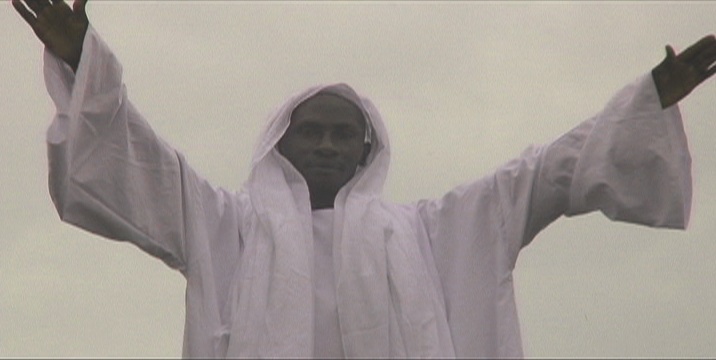
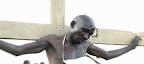
As Ssewanja gets to the top of the mountain he raises his arms out and looks down, creating the same iconic pose as the O Cristo Redentor statue of Rio De Janeiro. Christ the Redeemer is considered to be the largest art deco statue on earth. It is 130 feet tall, weighs 700 tons, and has been voted one of the New Seven Wonders of the World.

From my experience in making this film, I've learned that Uganda has more than its fair share of destitution. Domestic violence, corruption, disease, vigilante law, and malnutrition make day to day life difficult. In an environment like that, one can only have hope that things will one day change. Christ's transcendent qualities are often the only thing that keeps people going. Organized religion is the backbone of the community.
Closely linked to the church are the faith based charities that sponsor children.
 It's one way of creating redemption in rural villages, but is it beneficial for the community? Selected kids attend boarding schools in towns outside the village. When they go to University it's hours away in the capital. Those fortunate enough to pursue higher education become professionals in their careers. Yet, they are often reluctant to return to their homes after finding a better life elsewhere. That's redemption for the individual, but creates brain drain on the country. The best and brightest Ugandans don't even live in Uganda.
Foreign intervention by itself is not a viable solution. It fosters a culture of dependency that keeps things at status quo and often creates an environment vulnerable to corruption. Today Africa must struggle with an ill-fitting Western paradigm of development. It's structured in a way that the region will be forever playing catch up to the rest of the world. The continent's redemption must come from within. Africa is a wealth of natural resources and culture. Those who were fortunate enough to get out of Africa in search of better education and jobs must make the Christ-like sacrifice to return to their former life of poverty so that they can lead their people out. Africa needs to develop itself in a uniquely African way.
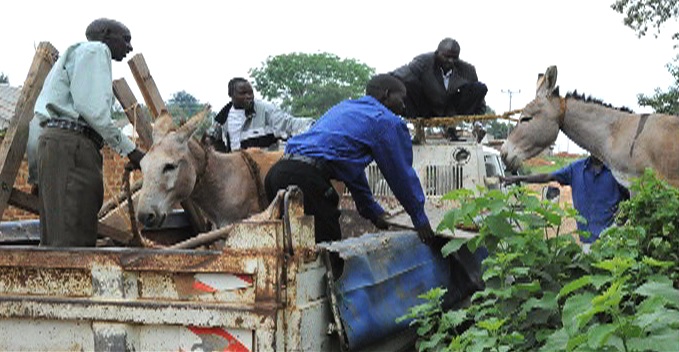
The donkeys were led single file over the gap. Led is not the best description. A few guys pulled at ropes tied at the beasts' necks. Another group pushed from behind. Some poked with sticks. I can't stress how risky it is to guide two large animals over a narrow, flimsy board over a ten foot abyss. Luckily, the donkeys made it onto the truck.
Yet, that's the way life works out in Kiwangala, Uganda. The people who live there are faced with seemingly impossible challenges. Often the only solutions are unpredictable and precarious, but everyday Ugandans take the chance anyway.
While working and living in the country I encountered a spirit of perseverance over adversity like no other. I mentioned in the introduction that making this film was difficult. It took a year just to sync the audio and figure out the subtitles. My inspiration to finish the movie came from watching the cast and crew. Seeing them balance the burden of the world on their shoulders put my work in perspective.
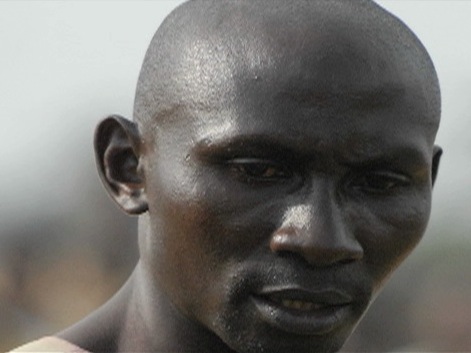 Sometimes, I'd question what I was achieving by making a movie about an African passion play. It seemed petty in light of the suffering these people are facing. What good is art if people are starving? Then one of the actors would see me working on my computer. I didn't have electricity at my house, but I would bring my laptop down the road and sit in a dusty garage that had an intermittently working outlet. The actors would come in, stand behind me, and watch me work. When they saw themselves or a friend or neighbor on the screen, even if it was just for a moment, they would erupt with excitement. They may have never seen themselves on video before, but they were eager to share their talents with an audience. It gave them a feeling of importance, a feeling that they weren't forgotten by the rest of the world, that they were more than just a third world statistic. The challenges that Sub-Saharan Africa faces doesn't boil down to economics, education, or management, but of esteem. When someone feels they are of worth they are capable of doing anything.
I certainly can't formulate a solution for all of Africa's problems in this closing paragraph, but I believe that media has a part to play. Awareness and advocacy comes from good communication. Giving the voiceless a voice is the first step in creating equality on the planet. These are ideas that I've explored in past posts and that I will continue to develop in future blog entries.
The Revealed Truth Blog Series
This is the final post of a nine part series that takes an in-depth look at the The Revealed Truth and how rural Ugandan culture influenced the making of the film. The movie is about an hour long but I've broken it down into 5 to 10 minute blog-size episodes. If you are reading about The Revealed Truth for the first time, the best place start is the introductory post.
The previous post was The Crucifixion.




 Posts
Posts


